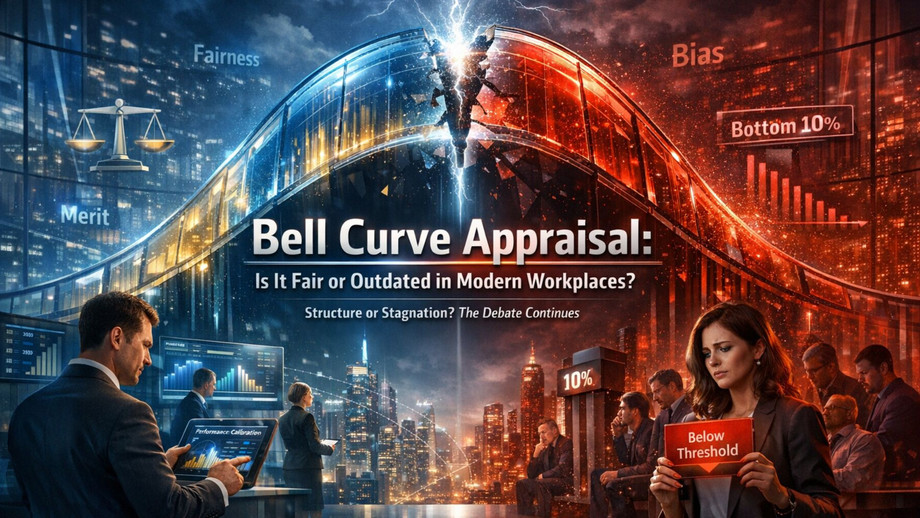
Have you ever wondered whether ranking employees against each other truly reflects their performance? Or does it simply force comparisons that may not tell the whole story? These are common concerns surrounding the bell curve appraisal system, a performance management method that has sparked debate for decades.
In simple terms, a bell curve-based evaluation ranks employees along a normal distribution. A small percentage are labeled top performers, the majority fall into the average category, and another small percentage are identified as low performers. The idea is to prevent rating inflation and clearly differentiate performance levels. But does this structured approach actually improve productivity and fairness? The answer depends heavily on how it’s applied.
A bell curve appraisal is a performance evaluation method based on forced distribution. Managers are required to categorize employees into predefined performance brackets that resemble a statistical bell curve.
Typically, organizations divide employees into:
The distribution percentages are often predetermined. For example, 10% might be rated exceptional, 70% average, and 20% below expectations. This structure ensures that not everyone can receive the highest rating, even if overall performance across the team is strong.
The purpose is to create differentiation. Without it, managers may give uniformly high ratings to avoid conflict or difficult conversations. The system attempts to introduce objectivity into what can otherwise become a subjective process.

Organizations adopt this model for several strategic reasons.
First, it creates clarity around performance standards. When everyone cannot be rated as outstanding, leaders must critically assess contributions and impact. This encourages more thoughtful evaluations.
Second, it supports compensation and promotion decisions. A clear performance hierarchy helps allocate bonuses, increments, and leadership opportunities in a structured and defensible manner. When categories are defined transparently, organizations can justify rewards based on measurable contribution rather than subjective preference, creating consistency in talent management practices.
Third, it identifies underperformance more visibly. Employees who consistently fall into lower categories are easier to recognize, enabling timely feedback, performance improvement plans, and strategic interventions such as Upskilling and Reskilling. For companies focused on measurable output and a competitive culture, this system often aligns with their operational philosophy, reinforcing accountability while maintaining a results-driven environment.
Despite its structured nature, this method has drawn significant criticism.
One of the biggest concerns is forced ranking. When teams perform at a similarly high level, managers may still be required to place someone in the lower bracket. This can create resentment and damage morale.